


You eat reasonably well, yet the tiredness after lunch, the bloating and the creeping weight gain keep coming back. In Traditional Chinese Medicine (TCM), that cluster of signs often points to spleen qi deficiency — and the first place we suggest looking is your everyday plate, not a herbal prescription. This guide to Chinese herbs for spleen support stays at food grade.
Quick answer
Chinese yam (Shan Yao) and coix seed (Yi Yi Ren) have documented traditional TCM roles for the spleen; millet, lotus seed, ginger and red dates are common Chinese home-cooking ingredients for gentle, warm meals. Eaten as regular cooked meals — think congee, soups and smarter hawker orders — they are a sensible foundation. Food alone is not a weight-loss treatment, and persistent signs deserve a registered TCM physician's assessment.
This guide is the everyday-eating companion to our prescriptions-focused article on herbs for spleen qi deficiency. That post covers medicinal herbs and classical formulas; this one stays firmly at food grade — what to buy at the wet market, what to order at the hawker centre, and how to cook it.
What does spleen qi deficiency mean for your weight?
In TCM, the "Spleen" is not just the organ your doctor checks on a scan — it is a functional system responsible for transforming food into qi (vital energy) and moving nutrients and fluids around the body. When that system runs weak, food sits heavier, fluids accumulate, and energy dips exactly when digestion needs it most.
The classic signs we ask about in consultation:
| Common sign | How it typically shows up |
|---|---|
| Tiredness after meals | A heavy, sleepy slump after lunch rather than refreshed energy |
| Bloating and fullness | A distended belly after modest portions, worse by evening |
| Loose or unformed stools | Digestion that never quite feels "finished" |
| Easy weight gain | Weight that climbs despite eating no more than before |
| Heaviness and puffiness | Limbs that feel leaden; morning facial or ankle puffiness |
That last cluster connects to dampness — a sticky, heavy quality that TCM describes as accumulating when fluids are not transformed properly. If puffiness and water retention are your main complaint, that pattern is treated differently — ask your physician which applies to you.
The practical takeaway: in TCM thinking, supporting the spleen means making digestion's job easier — gentler foods, warmer preparation, steadier timing — so the body spends less effort struggling and more on nourishing you.
Which Chinese herbs for spleen support are available as everyday foods?
These are groceries, not prescriptions. We describe them as foods with their traditional roles — no dosages, because food-grade eating is about regular inclusion in meals, not treatment protocols.
Chinese yam (Shan Yao)
A mild, slightly sweet root sold fresh at wet markets and dried in provision shops. A peer-reviewed nutraceutical review of Chinese yam records its long-standing use in TCM as a spleen- and stomach-supporting food, a tradition traced to the classical Shen Nong Ben Cao Jing. It is a food, not a treatment for any medical condition. In the kitchen, slice it into soups or steam it until soft; its gentle texture is why it appears in so many family tonics.
Coix seed / Job's tears (Yi Yi Ren)
Sold as Chinese pearl barley or Job's tears (Coix lacryma-jobi) — not the same grain as Western pearl barley (Hordeum vulgare), which is what most chilled barley drinks use. An academic review of Coicis Semen in Frontiers in Pharmacology describes it as both medicine and food, traditionally used in TCM to relieve dampness and support the spleen. It is the grain behind the familiar warm barley drink — though for spleen support we prefer it cooked into congee or soup, unsweetened, rather than as a sugary chilled beverage.
Lotus seed (Lian Zi)
A staple of Cantonese dessert soups and savoury stews alike. In everyday Chinese cooking tradition, lotus seed is regarded as a gentle, spleen-friendly food, commonly paired with Chinese yam in slow-cooked soups. Choose the version with the bitter green core removed for a milder taste.
Millet
A small yellow grain long favoured in northern Chinese home cooking for porridge. Congee made from millet — alone or mixed with rice — is a traditional breakfast for delicate digestion. It cooks quickly and takes on whatever broth you give it.
Ginger
Few Singapore kitchens are without it. In common culinary tradition, ginger is the warming companion to "cooling" or heavy foods — a few slices in fish soup, congee or a stir-fry. Warm ginger tea is a longstanding home habit for settling the stomach after rich meals.
Red dates (Da Zao)
The sweet dried jujubes found in every provision shop. They are traditionally added to soups, teas and congee as a gentle, nourishing sweetener — a way to make spleen-supporting meals pleasant without refined sugar. A few dates in a pot of soup is a food habit, not a dose.
Notice the pattern: nearly all of these end up in congee, soup or stew. That is not a coincidence — it leads directly into how you cook.
What do TCM-friendly Singapore meals actually look like?
You do not need to abandon hawker culture to eat for your spleen. The Ministry of Health has been working so that lower-calorie meals prepared with healthier ingredients — wholegrain staples, healthier oils, lower-sodium seasonings — become a prominent part of hawker and food-court menus. Those options align neatly with TCM's preference for lighter, less greasy cooking.
The Health Promotion Board's My Healthy Plate guidance, introduced in 2014, gives the proportions: half your plate fruit and vegetables, a quarter wholegrains, a quarter meat and others, with healthier oils and water as the default drink. Layer TCM's warmth-and-regularity habits on top of that plate and you have a workable everyday framework.
Here are combinations we commonly suggest — hawker orders, food-court swaps and simple home cooking:
| Meal | Why it fits spleen-friendly eating |
|---|---|
| Sliced fish soup with rice, extra vegetables | Warm broth, lean protein, minimal oil — easy on digestion |
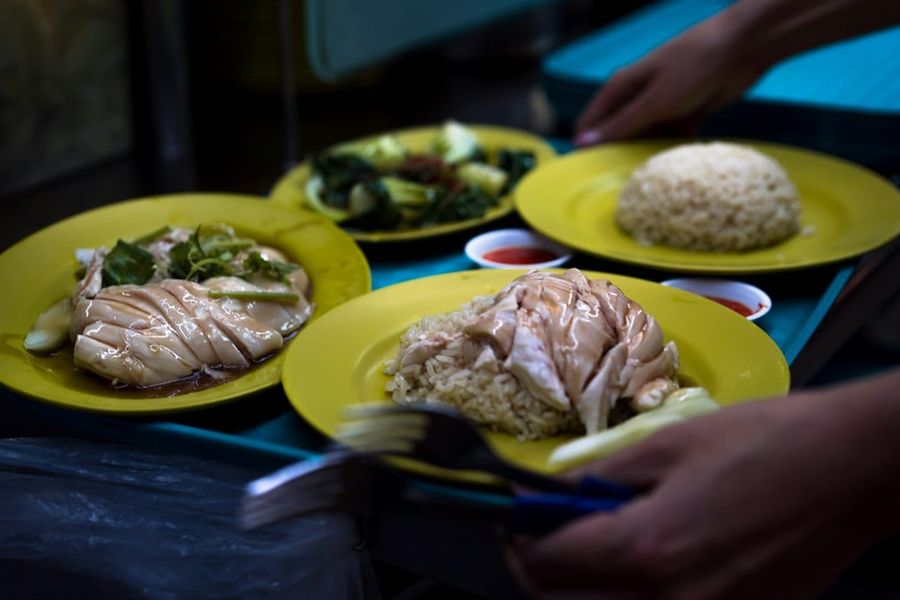
| Chicken rice with skin removed, soup on the side, less rice | Keeps the hawker favourite but lighter; ask for cucumber and greens |
| Yong tau foo in clear soup, mostly vegetables and tofu, go easy on fried items | Warm, varied, vegetable-forward; skip the sweet sauce |
| Herbal duck or pork rib soup (bak kut teh style), skimmed, with rice | Warm cooked meal; skimming keeps it from being greasy |
| Chinese yam and lean chicken soup at home | Yam is traditionally used to strengthen the spleen; slow cooking makes it gentle |
| Millet or mixed-grain congee with ginger and a little lean mince | The classic warm breakfast for a sluggish digestive morning |
| Coix seed and red date congee, lightly sweetened by the dates alone | Traditionally used to drain dampness while supporting the spleen |
| Steamed egg, stir-fried greens with ginger, small portion of brown rice | A ten-minute dinner that is warm, cooked and balanced |
For a longer list of stall-by-stall orders, see our guide to 25 healthy hawker orders for weight management.
Small ordering habits carry much of the benefit: ask for less oil and sauce on the side, choose soup-based over dry-fried versions, take the warm drink instead of the iced one, and add a vegetable dish whenever the stall allows.
Do cooking methods and meal habits really matter?
In TCM tradition, yes — how you eat is treated as seriously as what you eat. The reasoning is consistent with the spleen's job description: a weak transformation system prefers food that arrives warm, soft and on schedule.
The habits we recommend, as traditional practice rather than proven clinical findings:
- Favour warm, cooked food — congee, soups, stews, steamed dishes — over meals built mainly on raw salads and cold items. There is no clinical trial proving warm beats raw for weight; this is TCM's long-standing dietary logic, and many people simply find warm meals sit better.
- Go easy on iced drinks, especially alongside meals. A warm tea or plain warm water is the traditional pairing.
- Keep meals regular. Skipping breakfast then overloading at dinner asks a weak system to sprint after idling. Consistent timing is also plain sensible weight-management practice.
- Finish eating earlier in the evening and avoid heavy late suppers — a common recommendation for anyone whose bloating worsens overnight.
- Chew properly and eat unhurried. Eating fast at your desk between meetings is a common habit worth changing.
Start with one swap, not an overhaul
Pick a single change this week — warm congee instead of a cold sandwich breakfast, or soup-based yong tau foo instead of fried noodles. One sustainable swap beats a perfect plan abandoned by Friday.
When is food not enough — and who should be screened?
Food-grade eating is a foundation, not a treatment. If tiredness, bloating, loose stools or weight gain persist after several weeks of consistent changes — or if signs are significant from the start — it is worth a proper pattern assessment rather than more guesswork at the grocery store.
Two boundaries matter here.
Herbs are medicine, not groceries. Chinese herbal formulas should be prescribed by a registered TCM physician after face-to-face consultation. In Singapore, practitioners must be registered with the Traditional Chinese Medicine Practitioners Board (TCMPB) and hold a valid practising certificate under the Traditional Chinese Medicine Practitioners Act, as MOH explains. Do not self-select medicinal herbs or over-the-counter "slimming" herb products. For the medicinal depth — Shan Yao, Fu Ling, Zhi Gan Cao and classical formulas — read our companion guide to spleen qi prescriptions.
Are food-grade ingredients enough, or do I need a prescription?
Food-grade ingredients are for everyday meals; a physician-prescribed formula is needed when signs persist, are significant from the start, or require a dose matched to your constitution.
| Food-grade ingredient | Where you buy it | How it is used | When a physician-prescribed formula is needed |
|---|---|---|---|
| Chinese yam (Shan Yao) | Fresh at wet markets, dried at provision shops | Sliced into soups, steamed until soft, or cooked into congee | If tiredness, bloating or loose stools persist after weeks of consistent dietary changes |
| Coix seed (Yi Yi Ren) | Provision shops and Chinese medical halls | Cooked into congee or soup, unsweetened | If signs persist and a registered physician judges a formula appropriate |
| Millet, lotus seed, ginger, red dates | Supermarkets, wet markets and provision shops | Everyday porridge, soups and stir-fries | These are culinary ingredients; they do not replace a prescribed formula |
| Classical herbal formula (not food grade) | Dispensed after a face-to-face consultation with a registered TCM physician | Taken exactly as prescribed and adjusted to your pattern | Whenever a medicinal herb or formula is being considered — do not self-select |
Combining approaches has stronger evidence than diet alone. A 2024 systematic review and meta-analysis in Diabetes, Metabolic Syndrome and Obesity: Targets and Therapy found that acupuncture combined with lifestyle interventions produced greater reductions in body weight (mean difference −4.73 kg) and BMI (−2.11) than lifestyle interventions alone in adults with simple obesity. That is a finding about acupuncture plus lifestyle change — not about food therapy by itself, for which no comparable evidence exists. The pooled estimate comes from trials of varying quality in adults with simple obesity, so it describes study averages — not what any individual should expect, and not evidence for dietary therapy alone. That is why we treat dietary guidance as one part of a physician-led plan. The study does not predict results for our clients, and no outcome is promised — assessment comes first.
At Aimin, weight management starts with assessment: a physician consultation and a body-composition analysis before any treatment plan. Our slimming trial begins with that consultation and body-composition analysis — see the trial page for current inclusions and pricing. Results vary between individuals, and no clinic can responsibly promise a number before assessing you.
Who should be careful
If you are pregnant, taking blood-thinning medication, managing a chronic illness, or have persistent digestive symptoms such as ongoing diarrhoea or unexplained weight change, speak with a registered TCM physician — and your GP where relevant — before changing your diet substantially or starting any herbs or treatments. Always tell your physician everything you are taking. Food-grade ingredients are gentle, but your individual situation comes first.
What the evidence does and doesn't show
- Documented traditional use: Chinese yam (Shan Yao) and coix seed (Yi Yi Ren) have peer-reviewed reviews recording their long-standing TCM roles for the spleen, linked in the sections above and under Sources.
- Culinary tradition only: millet, lotus seed, ginger and red dates are described here as everyday Chinese home-cooking ingredients, not as sourced TCM medicines.
- No clinical evidence that food therapy alone changes body weight or resolves spleen qi deficiency. The meta-analysis cited above tested acupuncture plus lifestyle interventions, not dietary therapy by itself.
Can I strengthen my spleen with food alone, without herbs?
Food-grade eating — warm cooked meals, Chinese yam, coix seed, regular timing — is traditionally used to support the spleen and is a sensible first step. However, there is no clinical evidence that dietary therapy alone resolves spleen qi deficiency or produces weight loss. Treat food as your foundation, and seek a physician's assessment if signs persist.
Is barley water good for spleen qi deficiency?
Coix seed (Chinese pearl barley / Job's tears) is traditionally used to drain dampness and strengthen the spleen, per a 2023 Frontiers in Pharmacology review of Coicis Semen (PMC9995914). But the typical chilled, heavily sweetened barley drink is not what TCM has in mind — cooked, unsweetened coix seed in congee or a warm, lightly sweetened drink fits the tradition far better. Note that ordinary Western pearl barley and Yi Yi Ren are related but not identical ingredients.
Why do I feel tired and bloated after every meal?
In TCM, post-meal fatigue and bloating are classic signs of spleen qi deficiency — the digestive system struggling to transform food into energy. Modern causes like large portions, greasy food and rushed eating can produce similar symptoms. If it happens consistently, a registered TCM physician can assess the pattern, and your GP can rule out other medical causes.
How long should I try dietary changes before seeing a TCM physician?
There is no fixed rule, but a few weeks of consistent changes is a reasonable trial for mild signs. If tiredness, loose stools, bloating or weight gain persist or worsen — or come with other symptoms — do not keep waiting. Earlier assessment means a clearer picture and a plan matched to your constitution.
Your spleen does not need a miracle product — it needs meals that make its job easier, eaten warmly and on time. Start with the swaps above, and if you would like a physician's read on your pattern before going further, begin with an assessment, not a promise.
This article is general information about TCM dietary tradition, not personal medical advice. It does not replace consultation with a registered TCM physician or your GP.
Start with a consultation and body-composition analysis
Our slimming trial begins with a physician consultation and body-composition analysis — see the trial page for current inclusions and pricing. Call +65 6225 2321 or WhatsApp +65 9668 8771 — Central branch at 51 Cuppage Rd, East branch at Kensington Square, 2 Jalan Lokam.
See the slimming trial detailsSources
- A Frontier Review of Nutraceutical Chinese Yam — PMC (2024)
- Frontiers in Pharmacology review on Coicis Semen — PMC (2023)
- Acupuncture plus lifestyle interventions meta-analysis — Diabetes, Metabolic Syndrome and Obesity: Targets and Therapy, PubMed (2024)
- TCM practitioners registration — Ministry of Health Singapore
- Initiatives to support tasty and healthier hawker food — Ministry of Health Singapore (2025)
- My Healthy Plate — Health Promotion Board (2014)


